Friday, January 23, 2015

Top 10 Motorcycle Rides in North America


All bike riders know the feeling of flying … of freedom … that a great ride brings. Imagine those feelings intensified by the sheer beauty or fascinating landscape of nature’s best wonders.
To help you imagine (and maybe even go), we've chosen some of the best places in North America to take your motorcycle for a spin.

1. Route 50, The George Washington Highway, West Virginia.
How do you feel about lots of twists and turns? What a crazy question ... motorcycles were MADE for twists and turns.
Mountains ... check. Rivers ... check. Scenery ... check.
On the George Washington Highway, you'll ride just north of the beautiful Monongahela National Forest, and pass Cathedral State Park along the way too (which is a nice midway point stop).
And there's an added bonus -- once you've finished this adventure you are right there for two more of the East Coast's best rides -- Skyline Drive and The Blue Ridge Parkway!

2. Needles Highway, Black Hills, South Dakota
Needles highway is one of many roads you can take to get to the Sturgis Motorcycle Rally each August, and it feels like it was designed just to be experienced on a bike.
Riders who have whisked their way along the roads to get there often find themselves going much, much slower once there, without even realizing it.
Who can blame them?
The surrounding scenery is stunning. The highway passes through two tunnels blasted through sheer granite walls -- Iron Creek Tunnel and Needles Eye Tunnel. (The highway is named after the high granite "needles" it winds among.)
As for wildlife that might cause one to pause ... how about bison up close? And you'll get to see the actual spots where "the deer and the antelope play." Really. Just like the song.

3. Tail of the Dragon, Deal's Gap, North Carolina
It takes quite a bit of confidence to claim to be America's number one motorcycle and sports car road, as the website for Tail of the Dragon does. But with 318 curves in 11 miles, and one bodacious name, who would quibble?
Bordering the southeastern portion of the Great Smoky Mountains National Park, the ride can be spectacular.
If your tastes run to the macabre, check out the "Tree of Shame," a monument to the unfortunate souls who have crashed their bikes along the Tail of the Dragon. Bike parts are nailed to the tree and dangle from branches.
And just in case you need more testimony to its awesomeness, Tail of the Dragon is a Hollywood favorite ... having been featured in movies and television shows, including The Fugitive and Top Gear.


4. Blue Ridge Parkway, Virginia
Blue Ridge Parkway wanders through the Virginia countryside featuring a fair share of the local charms ... like an old mill pond with a working millwheel, as well as fascinating Civil War battle sites.
The lower half runs from I-77 to Cherokee, NC.
There you'll see the great Smokey Mountains of North Carolina, with countless overlooks to view the beautiful Smokies.
Below Ashville, NC are some of the greatest mountain views in the eastern U.S.
One of the best parts of this road is the fact that the only trucks ever encountered are the few service truck that service the two service station/restaurant areas along the parkway.
Also, the 45 mph limit makes lends itself to enjoying the surrounding scenery as safely as possible.

5. Beartooth Pass, Wyoming
Are you up for an adventure?
Of course you are. Well, this road will most definitely provide that.
It has more ups and downs that a soap opera marriage, very few guard rails and scenery you will never forget.
Everything from incredible mountains, dense forest, rivers (and even great rocks) ... to snow and tundra.
If you had to construct a great bike ride, it would look a lot like Beartooth Pass.
Expect to see as many bikes on this road as cars.
And you know that feeling when a roller coaster plunges straight down, and your breath leaves you for a second? There's a lot of that here, too.

6. San Juan Mountain Skyway, Colorado
Quite conveniently, San Juan Mountain Skyway is a loop, so you can start anywhere and take it either direction.
And if there is a more beautiful section of the Rocky Mountains, we haven't seen it.
You'll pass through historic mining towns, national parks and forests and world-class ski resort areas.
The San Juan Mountains are home to many of Colorado's elite group of 14,000 foot mountain peeks.
Want more?
Fortunate bikers who find themselves here will encounter red rock canyons, amazing river valleys, hot springs and majestic mountain peaks in a spot sometimes known as the "Switzerland of America."

7. Tunnel of Trees Road, Michigan
The Tunnel of Trees Road is ... not surprisingly ... one of the great forest routes in North America.
It's located about 35 miles from the very popular tourist stop, Mackinac Island, at the juncture of Michigan and Upper Peninsula Michigan.
You and your bike will hug the eastern shoreline of Lake Michigan through a dense forest, one side offering glimpses of old summer cabin homes tucked back in the forest, while the other side brings a quick peek or two of the Lake Michigan shoreline.
Ride north around the harbor to go through the town of Harbor Springs and up the coast ... the Northern Michigan coastline is just spectacular.
Tunnel of Trees Road is perfect for a fall ride during the color change -- try it in September for the very best vistas.

8. Cherohala Skyway, Tennessee
Between Knoxville and Chattanooga, the adventurous motorcyclist will find a ride like no other in North America.
Think Davy Crockett on a bike.
The Tellico River is well-known for trout fishing, and you are bound to see any number of canoes and kayaks along the waterway.
If you are looking for a pristine landscape to take you back to an earlier age, this is the ride for you.
But be warned ... It can be desolate at night and extremely dangerous in the winter months. There are no facilities other than restrooms for the entire 40 miles.
In other words, just like Mr. Crockett would have liked it.

9. Arkansas Pig Trail, Arkansas
The town of Ozark lies between Little Rock and Fort Smith, and that's where you'll want to pick up this trail, so aptly named in the state that made Razorbacks famous.
The rugged and forested Boston Mountains region of the Ozark Mountains is the setting for this route, which often runs through a tunnel of foliage during spring, summer and fall.
Spring wildflowers and brilliant autumn colors make the route especially popular during those seasons. The route crosses the Mulberry River and the 165-mile Ozark Highlands Trail.
And you'll encounter various hairpin turns, straightaways, and drop-offs where the cliffs seem to be right next to you.
Stop by the general store halfway through the run to get a pin proclaiming that you have ridden "The Arkansas Dragon."

10. The Three Sisters (aka The Twisted Sisters), Texas
Three Sisters starts in Medina, TX, and offers a 131-mile experience that will change your image of the state of Texas (unless you've already taken the ride, of course, in which case it will reinforce that image).
Think Texas landscapes are flat and boring?
The Twisted Sisters beg to differ. Breeze along beside clear rivers, maneuver your way along very twisty mountain-like curves with the added attraction of real J.R. Ewing, Texas-style ranches all around you.
And if you've a mind to do some fishing between rides, the Nueces River holds largemouth bass, smallmouth bass, and the native guadalupe bass, along with a variety of panfish such as redbreast sunfish, rock bass, green sunfish and Rio Grande perch.
Better keep the bike handy, though ... the river is home to lots of gators, too.

What do you think? Do these rides make your list, or are there some we missed?
Tell us on our Facebook page, HERE.

Tuesday, January 20, 2015

LEGENDS: THE "HOG BOYS"


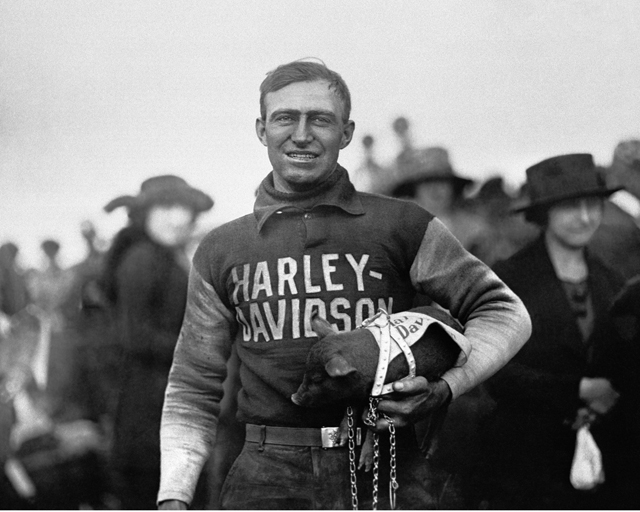
Today, Harley-Davidson trades on the New York Stock Exchange as HOG. Yes, it was an acronym for the Harley Owners Group, but that is not how they got their nickname. The original riders were a group of rough farm boys that rode for the Harley Davidson racing team in the 1910s-1920s. They would take their little pig mascot on a victory lap after every race their team name, giving them the pseudonym "Hog Boys." 
Safety was merely an afterthought during those days, and some of the early riders sacrificed their lives in pursing their dreams of going fast. What is impressive, though, is in spite of the tragedy, the rest of the community came together to support the families. In the case of Ray “Kansas Cyclone” Weishaar (pictured about), it meant raising money to pay off the mortgage of the family home so his wife and six month old could live there without worry.
Albert "Shrimp" Burns (above) was known as a gritty and tenacious racer who wouldn't think twice about racing injured. His fiercely competitive heart made him a legendary crowd favorite. I typical Burns' style, he once took a hard fall racing in Marysville, California but was unfettered. Still shook-up, he managed to get his bike back in shape and ready for the next race. He hopped back on and won the five mile final, which worked the crowd into a frenzy, all with a fractured collarbone and broken shoulder. In 1920, he switched from Harley Davidson to Indian, which was no small move in those days. He proved himself by taking home the very first national title of the 1920 season, winning the 25-mile national at Ascot in Los Angeles. According to reports, the crowd swarmed the track and carried Burns on their shoulders, cheering until they were horse. Burns was one of, if not the, most popular rider of his day.
Otto Walker, (above) was a leading motorcycle racer in the 1920s and early 1920s and one of Harley Davidson's first factory riders. Walker won the first major race for the Harley Davidson factory team on April of 1925: an FAM 300-mile road race in Venice, California. Walker set numerous speed records during his eight years of professional racing. In 1921, he earned the impressive distinction of the first rider ever to win a motorcycle race at an average speed of over 100 mph.
afv-2-harley-hog640
Many of these guys went on to advance the world of motorsports and promote motorcycles in other venues. The rider Jim Davis helped the Ohio State Highway Patrol to form their motorcycle enforcement division. They deserve a great deal of respect. More than one paid the ultimate price and left it all on the track for the sport that was their life: racing motorcycles. Many of us cannot begin to fathom the depth of their personal commitment and sacrifices. We wouldn’t be where we are today without their efforts.


Monday, January 19, 2015

African American Biker Gang - Freedom Riders

Monday, January 19, 2015, is the day we set aside to observe the contribution of Martin Luther King Jr. in his fight for civil rights for disadvantaged Americans. While it is important to remember his
contributions in that fight, it is also a time to remember others including veterans who have long fought to make certain that every American can enjoy the liberty guaranteed in the Constitution. There are also the contributions made by ordinary citizens over the decades that have protected or even provided for new rights for certain citizens that did not previously have them.

I have heard many people comment that this is an ‘African American’ holiday – and I assume they think that way because Martin Luther King was African-American and fighting for the rights of other African-American citizens, but MLK Day is an’ American’ holiday made possible by people like Martin Luther King who believed so strongly in what they were doing, they dedicated their life to the betterment of our society. Americans have always enjoyed some of the most precious of freedoms. We can pretty much say what we want, when we want, to whomever we want providing we do not incite violence against others or threaten others with harm. Few others around the world have such privilege. But with these wonderful rights we have as Americans, comes responsibility. We have the responsibility to protect these rights for the next generation and beyond just as those before us did FOR us. 

Over the years many different groups of citizens came together to either forge a trail to protect what
they felt was a given right, or worked collectively to protect what was already established as a right of every citizen. From segregation to the wearing of protective helmets while operating a motorcycle; 

Americans have always come together when threatened with the loss of liberty.In observing MLK Day or Civil Rights Day, let’s not forget what a remarkable place we call home. It does not matter which way your political alliances lean, or what your religious affiliation is, or even your sexual orientation or your race is – it is a day to remember what it is to be an American! Various people, including Martin Luther King have stood up over time to force the establishment to protect what was 
granted by our forefathers. Let’s always remember to strive to protect those rights and share them with the next generation to allow the American way to thrive and prosper.


I came across this article on the internet that highlighted a pioneering African american Motorcycle Club and was inspired by their history I am re-posting the article here.. 

It was written by: Messy Nessy - And we are reposting it here on our blog

Freedom Riding on a Harley: The 1950s ll-Black Biker Gang
17TH JUL, 2013
East Bay Dragons
While Rosa Parks took her historic bus ride, and as Dr. Martin Luther King Jr, Malcolm X and Huey P. Newton and the Black Panthers stood bravely for equal rights, the East Bay Dragons MC risked life and limb during days when a black man riding a Harley chopper was a revolutionary act.”
The East Bay Dragons of Oakland, California was founded in the 1950s as a car club under the leadership of Tobie Gene Levingston,  an associate of Sonny Barger, the founding member of the California Hells Angels, who’s main goal was to keep his younger brothers and friends occupied and out of trouble. In 1959, the club switched to Harleys and Choppers to become an ‘outlaw’ motorcycle club, The East Bay Dragons MC, one of the first of its kind.
On two wheels, the all-black, all-Harley, all-chopper group of motorcyclists haven’t exactly had an easy ride over the decades, encountering their fair share of violence, rivalry and racial tensions on what they call the ‘battlegrounds of urban America’.
“East Bay Dragons have secured their place as modern urban folk heroes alongside the Hell’s Angels, the Oakland Raiders, and the Black Panthers … Their legacy is an untold portion of African-American history.”
Apparently they now also enjoy watching Sons of Anarchy at their clubhouse!
I went snooping through their club’s photo albums on their website and found some pretty rad images…
East Bay Dragons
East Bay Dragons
East Bay Dragons
East Bay Dragons
Group - East Bay Dragons
East Bay Dragons
Purple Chopper - East Bay Dragons
Bags - East Bay Dragons
Jacket Back - East Bay Dragons
Empty Bikes - East Bay Dragons
Group With Trophy - East Bay Dragons
The story of the East Bay Dragons has now been told in a book co-written by founder Tobie Gene Levingston, called Soul on Bikes.
Images (c) East Bay Dragon

Friday, January 16, 2015

What are the best biker rallies in the U.S ?

Every year, motorcycle enthusiasts who love a party atmosphere gear up and make the rounds of seasonal motorcycle rallies, bike shows, swap meets and poker runs.


While most motorcyclists attend such events close to home, literally hundreds of thousands make a pilgrimage to what are widely considered the top motorcycle rallies in the country. The Sturgis Motorcycle Rally, Rolling Thunder's “Ride for Freedom,” Daytona Bike Week, Laconia Motorcycle Week or Myrtle Beach Bike Week inevitably lead the rest when it comes to must-see biker events.


Most Rally’s are extremely generous in giving back to the community or a charitable organization. One of the best fund raisers is a poker run. Each checkpoint is another opportunity to join in more entertainment and events. The Checkpoints are where the cards are given and the best hand is awarded at the end of the ride.


Rally’s are known for some of the best musical acts like Aerosmith, Lynard Skynard, Motley Crue, Alice Cooper, and many more. Also you can never forget the dare devils that put on a great show.


Freestyle Motorcross acts from the likes of the Metal Mulisha or Extreme acts from Doug Danger.


Drag Racing has became a huge part of these events. Some of the fastest and most outrageous bikes are designed every year to step up the level of speed and power. Street Bikes, Harleys, Trikes all declare war with one another to best the fastest. Usually you can find a great Burnout Competition at the same event.


The Sturgis, South Dakota, rally is considered the premier motorcycle event in the United States. It began in 1938 as a race called “The Black Hills Classic,” attended by only nine participants, their friends and families. It's grown into a mecca for bikers, attracting an estimated 650,000 motorcyclists from around the world every August. Not bad for a town of less than 7,000.


The Laconia event in New Hampshire is the oldest, first held in 1916 with only a couple hundred bikers in attendance. That first rally at Weirs Beach included a weekend of hill climbs and races. Nearly a century later, the annual mid-June event has an estimated attendance of more than 300,000.


Florida's Daytona Bike Week began in 1937 as a one-day, three-mile-long beach race for motorcyclists. The event now attracts more than 500,000 participants and runs for 10 days every March. The town also hosts “Biketoberfest” every October during the weekend closest to Columbus Day.


In South Carolina, Myrtle Beach Bike Week has been held annually since 1940. Although the Myrtle Beach City Council declined to continue hosting the event in 2008, that didn't stop local businesses and property owners. They continue to host the event for two weeks beginning in early May.


While it operates under the same name, the rally is now held in Murrells Inlet, South Carolina. Annual attendance is about 300,000.


Of all these events, Rolling Thunder's annual “Ride For Freedom” Memorial Day rally and run is one of the most noteworthy. The rally began in 1988 as a demonstration organized by four Vietnam War veterans and their families to protest the plight of American POW/MIAs. That first run, starting at the Pentagon and ending at the Capitol Building, barely made national news. What began with 2,500 motorcycles has grown into an annual charity event attracting nearly 500,000 bikers and thousands more veterans, vendors and participants.

Tell us what are your favorite rides and rallies are. This year we plan to be a part of some the best rallies across the country either as a vendor or participant.


Friday, January 9, 2015

History of Victory Motorcycles

     
Victory Motorcycles has put together some truly historic bikes in its short 17 year existence. When purchasing a Victory you can expect true high performance and high mileage capability. Now, don’t get us wrong,  we love our Harley Davidson’s and everything Harley has provided over the years, but it's nice to know there is another option for baggers, v-twins , touring & cruising bikes made in America.

     Parent company Polaris, created Victory with one thing in mind; to compete with Harley Davidson and make an American Bagger with a different approach than the competition. For over 70 years there had been no alternative to a true American Bagger Motorcycle until1997 when Victory 
introduced the V92C.


     Al Unser Jr. introduces the V92C for the first time at Planet Hollywood in the Mall of America. In 1998 they started production of a 92 cu in (1510 cc) making it the 2nd largest motorcycle engine produced and available at the time. It created a stir and a race to see who could produce bigger and better engines for today's bikes. All of the components for the V92C were manufactured in Minnesota and Iowa, with the exception of Italian Brembo brakes and the British-made electronic fuel injection system. Victory engines debuted with five-speed transmissions, single overhead cams, dual connecting rods, hydraulic lifters, and fuel injection. In designing the engine they made it so it can easily be tuned by the bike owner.

     Since the introduction of the V92C Victory began producing a Sport Cruiser and Touring model. They really wanted to make things different with their Freedom Engine .  It had the same dimensions as the old engine but with higher power output, and with rounded cylinders and smaller oil cooler, it was much more attractive visually.


     Victory ended production of the V92C in 2003; however, it's still known as the classic cruiser and a favorite  by Victory enthusiasts everywhere
    .

     The next big thing was the Vegas introduced in 2003. The Vegas was designed by Victory designer Michael Song, and offered a totally new chassis design and using the Freedom engine. The Vegas debuted with the 92 cu in (1,510 cc) engine and 5-speed transmission, but was upgraded to a 100 cu in (1,600 cc) engine and 6-speed transmission for the 2006 model year.

     Some say this is the bike that really made a name for a Victory and really started to make them a profitable and well known American Motorcycle company.

     Over the years Victory has made 15 models of bikes. They have learned to market to all motorcycle enthusiasts and bikers alike. From your basic weekend warrior to your die hard cross country rider. If one thing is for certain Victory plans to get more creative and inventive with their bikes and engines and really want to change the American Motorcycle Market. The question is what will they come up with next?

victory line up.jpg

Wednesday, December 10, 2014

When Hogs Fly


When you think of a Harley, you don’t typically think of them flying through the air, at least not on purpose. But a little known fact, is that throughout the history of Harley Davidson, a few enterprising individuals have dared to take their Hog airborne. Follow LRS as we explore the history of the flying Hog.

            The world record for the longest jump on a Harley (or any motorcycle) was originally set in 1975 by Robert Knievel, AKA Evil Knievel when he jumped his bike 115 feet over 14 Greyhound buses in Cincinnati, Ohio. 
Evel made 300 jumps in his career, 273 of them were successful, the rest....  Not so much!

     This record was later broken by Bubba Blackwell in Las Vegas, Nevada when he topped Evil by 1 Greyhound bus and jumped 157 feet.

            While both of these jumps were impressive, the record would again be challenged by motocross legend Seth Enslow in 2010, in Sydney, Australia. Enslow would take his Harley XR1200 to new heights and lengths, as he jumped an astonishing 183 feet to shatter the previous world record for the longest jump on a Harley Davidson.


     We’ve all heard the expression “when Pigs fly”, well these daring individuals had the courage, audacity, and perhaps a touch of insanity, turn the figure of speech into a reality and make hogs fly.
     These examples of modern day jumps are fascinating, but the the roots of flying bikes, go even deeper, dating back to as early as World War 2. During the war, soldiers often prided themselves on being able to jump their hard-tail bikes across ditches, trenches, and even fences in order to move quickly and efficiently across the battlefield.

     It seems that ever since man has been moving on two wheels, the desire to move those two wheels into the air has been a driving force for many riders. Early racing even included jumping, and has been a staple of motorcycle racing ever since. 
   
 The desire to make Hogs fly is not a new concept, and the idea continues to inspire us to new heights, as it did our riding ancestors of days gone by. Thinking of these days brings into sharp contrast the difference between a generation unafraid to take real challenges and risks, and many of our youth of today who only take risks in the online world of Call of Duty...


Friday, December 5, 2014

APACHE TEARS!

The Legend of the Apache Tears

We are all getting frustrated with the cold weather here in Reno, Nevada. So we started to look for warm places where we can stretch our legs and enjoy a refreshing ride without having to dress like Ralphy from The Christmas Story.


But we never take off without an interesting destination in mind. This one piqued our interest. Arizona, here we come!

Many years ago the Apache rode free across the valleys and mountains of southwestern United States, including what is now Arizona. The land, like the Apache, was rough but noble. Sunset mountains cut across miles of desert sands. Only the hardiest plants survived in the harsh conditions found on the faces of these towering rocky cliffs. The mountains and surrounding desert landscape kept the Apache safe from enemies far longer than other tribes who had settled in more fertile, and far more open areas. In the end, however, encroaches came searching for the precious metals contained within the mountain rock.

The Apache fought fiercely to defend their homes and families. They maintained their strong fighting spirit even though the odds were against them. Small groups of Apache warriors made life miserable for their enemies, hoping to drive the intruders away. They raided campsites, stealing horses and cattle. They ambushed supply caravans, taking food and weapons for their own use. They attacked when least expected, catching their enemies off guard. For awhile tactics of the Apache warriors worked, but the lure of gold and silver proved too strong. The men, with no regard for the Apache or his land, were determined to establish their settlements and seek their fortunes in the mountains.

Finally, a large cavalry unit was sent out to hunt down the Apache warriors. A warrior party of seventy-five Apache galloped to the top of a pink-hued mountain, chased closely behind by the cavalry. The warriors wheeled their horses around, realizing they were trapped. In front of them,
hundreds of cavalry officers circled, guns in hand. Behind them, the sheer face of the mountain plummeted hundreds of feet to the desert floor. At a signal from their leader, the officers fired. In the first round of shots, fifty Apache died. The remaining twenty five warriors were trapped and faced death at the hands of their enemies. These men knew there was no way out. Rather than be killed by the enemy, the remaining Apache warriors spun their horses around and leaped over the edge of
the mountain.

When the Apache women and children discovered their fathers, husbands, and sons dead at the bottom of the cliff, their tears fell. Each tear drop, as it hit the hard, dry earth, turned to black stone. They mourned the death of their warriors. They mourned the loss of their fighting spirit. They mourned the life they had carved in the Arizona desert. Soon the ground at the bottom of the
mountain, once bleached white from the searing sun, was blackened by Apache tears.


It is said that a person who finds one of these tears beneath Apache Leap Mountain will never need to cry again, for the Apache women cried tears for all who mourn. These beautiful translucent gemstones of obsidian are now known as Apache Tears.